
Artificial Intelligence (AI) is no longer a futuristic dream. It’s here — and it’s changing the way we live and work faster than any technology in history. From chatbots and self-driving cars to advanced medical diagnosis and automated trading, AI breakthroughs are revolutionizing entire industries. But with these innovations comes a pressing question: is your job at risk?
In this article, we’ll explore the latest AI breakthroughs, the industries most affected, the jobs at highest risk, and how you can prepare for the future.
The Revolutionary AI Breakthroughs Shaping 2023 & Beyond
Recent years have seen AI evolve from basic automation into something far more powerful:
- Generative AI (ChatGPT, Bard, Claude, MidJourney): Creates text, images, and videos.
- AI-Powered Healthcare: Diagnoses diseases faster than doctors in some cases.
- Self-Driving Technology: From Tesla to Waymo, autonomous driving is becoming reality.
- Financial AI: Algorithms predict market movements and execute trades in milliseconds.
- Manufacturing & Robotics: Smart robots can adapt, learn, and work alongside humans.
These breakthroughs are boosting efficiency and cutting costs, but they’re also raising concerns about human employment.
Jobs Most at Risk from AI Automation
Not all jobs are equally threatened. AI is most effective at tasks that are repetitive, data-driven, or rules-based.
⚠️ High-Risk Jobs:
- Customer Service Representatives – AI chatbots can handle customer queries 24/7.
- Data Entry Clerks – Automation software easily manages repetitive input tasks.
- Basic Content Writers – Generative AI tools produce articles, ads, and social posts.
- Telemarketers – AI-powered voice systems make automated sales calls.
- Accounting Assistants – AI software can manage bookkeeping and financial reports.
Industries Being Transformed by AI
- Healthcare – AI is improving diagnosis accuracy, reducing wait times, and even assisting in surgery.
- Finance – Fraud detection, automated trading, and customer service are now AI-driven.
- Retail & E-commerce – Personalized shopping experiences and automated checkout systems are common.
- Transportation – Autonomous vehicles and delivery drones are transforming logistics.
- Education – AI tutors provide personalized learning experiences for students.
Jobs Less Likely to Be Replaced
While some jobs are at risk, others are far more resistant to automation. These roles usually require human creativity, empathy, and critical thinking.
✅ Safe(er) Jobs Include:
- Teachers & Educators (human interaction remains crucial).
- Creative Professionals (designers, filmmakers, high-level writers).
- Healthcare Workers (nurses, therapists, specialists).
- Engineers & Scientists (AI enhances but doesn’t replace innovation).
- Managers & Leaders (decision-making requires human judgment).
How to Future-Proof Your Career
The key to staying relevant in an AI-driven world is adaptability. Here’s how you can prepare:
🔹 1. Learn New Skills
Focus on areas where AI struggles, like creativity, problem-solving, and emotional intelligence.
🔹 2. Embrace Technology
Instead of resisting AI, learn how to use it. Professionals who can work with AI tools will remain valuable.
🔹 3. Invest in Continuous Learning
Take online courses in AI, machine learning, data science, and digital tools relevant to your field.
🔹 4. Shift Toward Human-Centered Careers
Jobs involving leadership, empathy, or complex decision-making are harder to automate.
🔹 5. Develop a Growth Mindset
AI will keep evolving. Workers who adapt quickly will always have opportunities.
The Human-AI Collaboration Future
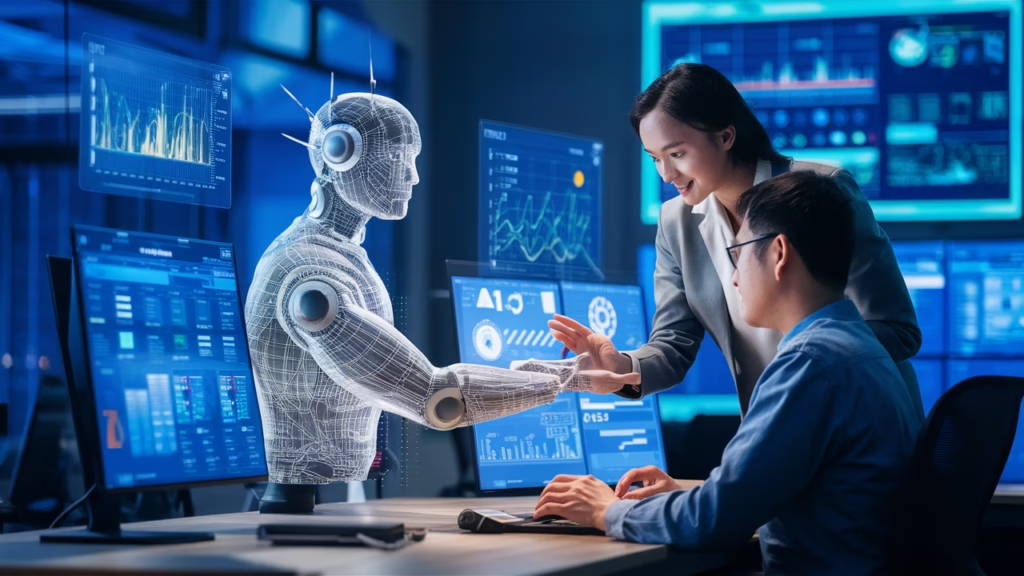
It’s important to remember: AI isn’t just about replacing jobs — it’s also creating them.
For every role automated, new opportunities are emerging in:
- AI system development
- Data analysis
- Cybersecurity
- Digital marketing
- Human-AI ethics and policy
The future is not about AI vs. Humans, but about AI + Humans working together.
✅ Final Thoughts
The AI revolution is here, and yes — some jobs are at risk. But history shows that every technological leap creates new industries and opportunities. Just as the Industrial Revolution transformed farming jobs into factory jobs, the AI revolution is shifting us toward a more digital, knowledge-driven economy.
Your best defense? Stay adaptable, keep learning, and embrace AI as a tool — not a threat.
The question isn’t just “Will AI take my job?” — it’s “Am I ready to evolve with AI?”
 admin
admin